Teaching blog with lesson plan ideas (and free downloads!) for music teachers looking to incorporate Gordon's Music Learning Theory into their music classes!
Showing posts with label movement. Show all posts
Tuesday, May 22, 2018
Hop, Hop, Hop: Lydian Easter bunny song
Also out of season for this, but of course you could perform it without the words for your students. This is another Lydian tune I wrote to an existing chant, Hop Hop Hop. It works well as a movement activity with students hopping in different ways (for example direct and indirect pathways, on macrobeats or microbeats, or discovering the difference between hopping and jumping) around the room!
Wednesday, December 13, 2017
Beehive!
A new melody for an existing chant (not sure who wrote the chant). First graders love this song and set of activities!
- Day 1: Start the students on an ostinato sung on the resting tone on macrobeats: "1, 2, 3, bzz, 1, 2, 3, bzz," having them tap the macrobeat on their legs for the first three beats and on their shoulders on the buzz. Sing the song over the ostinato. If you are using the words the first day of the song, display the words to students with bees, sees, hive, and five underlined, guiding them to notice that the "bzz" happens at those spots. Then, have 5 students pretend to be the bees, walking around the outside of the circle on macrobeats, gently tapping one student's should only on the buzz parts of the ostinato. Have the bees perform a major or triple pattern, and appoint five new bees, singing the last line of the song as you choose them.
- Day 2: Have students flow during the song as if they are bees flying in curvy pathways. Use this free TpT bumblebee animated vocal exploration SMART board file to have students explore their head voices between repetitions, having one student come up to the front to click the smart board and echo a triple meter pattern. For other repetitions, have students move the ostinato from day 1 again, changing which body part they sting themselves on for the buzz every time.
- Day 3: Use the song for a locomotor movement activity. Guide the students to explore curvy and straight pathways ("beelines" 😃) around the room. Have them fly high or low. Have them find closed or small shapes like they are the bees hiding, or open and large shapes like they came out of the hive. At the end of the activity, ask the students to "fly back to their nests" returning to their spots.
- Have one student hide a toy bee around the room like it is hidden in the beehive as the rest of the students close their eyes. When the song is over, have students open their eyes and point quietly when they see the bee. Someone who pointed quietly will get to hide the bee next, and anyone who gets a turn performs a triple or major pattern.
- Use the toy bee to go around to students during the song, pausing after every line to "sting" a student with a dramatic resting tone buzz! Invite the student you sing to perform the resting tone as well.
- Have students find the DO SOL MI patterns and sing DO SOL MI on solfege or on BUM BUM BUM in the song every time it occurs. They could also look at the notation for that pattern if they are ready for symbolic association, or they could replace it with different major tonic patterns that they create singing or writing and singing.
- Have students sing chord roots (DO DO FA DO, DO DO SOL DO) and possibly transfer that to instruments.
- Connect to the major tonic patterns in the song by playing the major tonic game. My version of the game: Students listen to patterns and jump after they hear a major tonic pattern, singing "major tonic," and they squat after they hear a major dominant pattern, singing "major dominant." If they are incorrect they sit down where they are and are out until the next round. Perhaps add subdominant in there since it is part of the song's progression!
Notation is here if you want to edit or display it in higher quality to your students.
Labels:
1st grade,
2nd grade,
individual response,
Kindergarten,
Major tonality,
movement,
music reading,
ostinato,
resting tone,
singing voice,
SMART board files,
songs,
subdominant,
triple meter,
vocal exploration
Friday, July 21, 2017
Day in the Park: Mixolydian song and movement activity
A new Mixolydian song and movement activity!
Sing the song on a neutral syllable as students walk to macrobeats, then microbeats.
Have students audiate the resting tone of the song. Then have them breathe, jump, and sing the resting tone when they land (feel free to add some story imagery here related to what they're jumping on at the park!).
Have the students do the walking activity again, this time giving a high 5 the person they're closest to at the end of each phrase (the second half note in m. 4 and m. 8).
Then, during the last repetition, have the students sing the resting tone as they high-5 the person they're closest to at the ends of phrases.
In other days with the song, let the kids use their imaginations to create park related movements to do! Perhaps they can pretend to walk a dog on microbeats, swing their arms as if they're on the swings on macrobeats, alternate beats with their hands in high space as if they're on the monkey bars, perform vocal exploration like they're going down the slide...sky's the limit!
Forest: Dorian tune and activities
Another new tune for you!
Activity ideas:
- Do a story-related seated or locomotor movement activity: What could the hiker see next in the forest? Should we pretend it's a scary forest at night (with Halloween characters) or a sunshine-filled forest in the day (with different animals)?
- Have students move macrobeat and microbeat simultaneously, both stationary and locomotor
- stationary (macro in heels, micro in fingers tapping different body parts)
- locomotor (macro with feet walking, micro in hands patting)
- The locomotor activity can have kids take turns taking "a walk through the forest" by crossing the circle. The class stays on the edges of the circle, and the teacher says "[student's name], ready go!" and the student crosses to the opposite side of the circle with this locomotor movement with macro and micro going at the same time in their walking and their patting.
- Pair with duple patterns, group and individual
- Do AB or ABA movement opposites: measures 1-4 staccato flick motion or flow with pulsations, measures 5-7 legato side-to-side motion with hands or swaying whole body. Measure 8 could be back to staccato, or still legato, depending on teacher preference and student age.
Wednesday, November 18, 2015
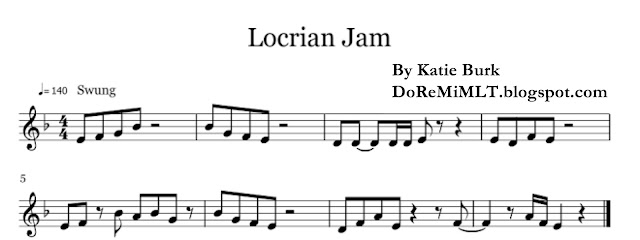
Locrian Jam song!
This song works well with movement activities. Students explore Laban efforts around the room in self-space after spinning our "movement spinner." Another activity for the song: A student with a sign that has Macrobeat written on one side and Microbeat on the other turns the sign to whatever beat they want the class to move to, switching every 4-8 beats. This is also a fun song to have students try snapping on beats 2 and 4, or for students to have a partner that they share a rhythm stick with, swaying side to side or back and forth on macrobeats or microbeats, with each student holding one end of the rhythm stick.
2017 addition:
Here is an optional B section that you could use for activities such as circle dances or Laban movement opposites! Still swung. :)

Saturday, December 13, 2014
Christmas circle game: tonal creativity focus
I do this with the song "Santa Claus is Comin' to Town," as a way to take a song from my school's holiday sing-along and make an MLT classroom activity out of it. You could also substitute any Christmas song for it. Here's the game:
- All students sit in the circle and keep the beat to the song. Choose 1 kid to be the first Santa. Santa creates a major tonal pattern (at Aural/Oral or Verbal Association, whichever level your students are at), and all students repeat that pattern after Santa.
- Then everyone except Santa closes their eyes, and Santa chooses one of two very small toys to hold in their hand. This could be any 2 items small enough to fit in a child's hand; I use two tiny polar bears, one with red on the bottom and one with green. One of the toys represents "Naughty" and the other represents "Nice." (With the 2 toys I use, the red polar bear is naughty and the green one is nice.)
- Santa hides the toy they picked in their hand, and the teacher hides the toy Santa DIDN'T pick in the teacher's own hand.
- Then Santa walks around the inside of the circle to the beat of the song as all students sing. Santa can even move as if they're carrying a heavy bag of toys, adding heavy movement exploration to the activity. At the end of the song, whoever Santa lands in front of guesses whether Santa has the Naughty toy or the Nice toy in their hand. If they are right, they get to be the next Santa. If they are wrong, the same kid gets to be Santa again. After they guess, whether they're right or wrong, they share their own tonal pattern for the class to repeat!
- If the guesser was wrong, all kids close their eyes again and the same Santa gets to either change which toy they have or keep the same one. If the guesser was correct, the guesser is the new Santa and picks the toy as all kids close their eyes!
Tuesday, December 2, 2014
Holiday hello song #2: based on Sing We Now of Christmas
A 5/8, secular, hello song based on the Dorian tune "Sing We Now of Christmas." The Noteflight notation is here if you'd like to adapt it for yourself.
Some possibilities for classroom activities with the song:
- You could do the song in duple or triple meter instead of 5/8 and use it to have students echo specific LSA patterns in between repetitions of the song.
- You could do the song without words for early childhood or lower elementary classes.
- Olaf activity:
- Take a snowman prop and pretend he’s Olaf from Frozen. Tell the students we have to tell Olaf with our “BAH” rhythm words that he’s going to melt in summer! Olaf will say something to you, you repeat it back to him to tell him about how snow can’t be warm. Students echo rhythms after Olaf on "BAH.
- Decorating a Christmas tree activity:
- Have students sit and move with flow like they are putting a string of lights around a tree.
- Explore different levels of space based on how students are decorating the tree:
- flow high to put the star on,
- flow low to put presents under tree,
- flow medium-high to put ornaments on,
- do ABA to combine star and presents with motion going high when song is high and low when song is low
- Lift hands and put them down to sing 5-1.
- Singing 5-1, individual students sing after the teacher:
- “touch the top of the tree, bottom of the tree”
- “ceiling, floor”
- “head, toes”
- “high, low”
- Students pretend to put something on the tree and "touch the tree" as they echo a tonal or rhythm pattern after the teacher.
- Repeat the song again, pretending to put more decorations on the tree with flow or beat movement.
o
Thursday, October 16, 2014
Viennese Musical Clock movement to Rondo Form
Got this lesson from the amazing teacher I student taught with. This video is too cute not to share!
Students created all the movements in the video except the clock movement for the A section. The B, C, and D sections show the toy soldiers that come out on the hour. A student "conductor" points to where they are in the form.
Lessons leading up to this:
- Reviewed AB and ABA form.
- Learned the term rondo form by making different forms out of the songs/chants "Hop Old Squirrel," "Whisky Frisky Hippity Hop" (both Jump Right In 1st grade), and "Gather acorns in the fall, little squirrel must do it all."
- Moved to this piece, Kodaly's Viennese Musical Clock, section by section then putting it all together, asking what form is it if we stop here? What form is it if we add this?
- The original movements to Viennese Musical Clock:
- A section: move hands like the minute and hour hand of a clock
- B section: the toy soldiers come out and play trumpets
- A: clock again
- C: the toy soldiers salute on the beat
- A: clock
- D: the toy soldiers march (move locomotor for the B, C, and D sections once the kids know the piece)
- A: clock
- coda: arms up on the big chords! :)
- Finally, students came up with their own "toy soldier" movements. (This class chose swaying their arms, jumping, and marching locomotor.)
Tuesday, October 14, 2014
Ghostbusters move and freeze!
Got this Halloween idea from my mentor... Play the Ghostbusters theme song. They start the song by moving/dancing in self space.
When the kids hear the word "ghost" or "ghostbusters," they freeze.
When they hear it again, they move.
When they hear it again, they freeze.
Etc.!
They have to really be listening to the song to figure it out when to move and when to freeze! You can add rules like they're out if they move when they should be frozen or vice versa.
Good body awareness activity. And the kids beg for it!
Tuesday, July 29, 2014
All Around the Daffodils game
Materials: 2 fake daffodils
Students stand in a circle, holding hands up. Two students get fake daffodils that they will give to other students. The 2 students weave in and out of the circle, finally landing in front of someone at the end of the song. The person they each land in front of sings the resting tone of the song and gets the daffodil. Then they weave in and out of the circle, landing in front of someone else!
Alternative movement from http://www.letsplaykidsmusic.com/easter-spring-song-daffodils/ :
The children stand in a circle and hold hands up high to form arches or windows. One child is chosen to hold the small bunch of (fake) daffodils, and starts to weave in and out of the windows. As the words ‘just choose me!’ are sung, the first child takes the hand of whoever is the closest, and then the two children carry on going in and out of the windows. The song is repeated until all the children are holding hands in a long snake, an adult can make a bridge against the wall, and then they all go round and under the bridge for a last time.
Wednesday, July 23, 2014
Paper skates!
Around the holidays (and Olympic season this past year!), at the end of class I occasionally give my younger grades the opportunity to ice skate in music class! I take paper from the recycling bin, cut it in half, and each half of the paper is a skate that the student gets to pretend to skate on.
I put on a song like "Skating" by Vince Guaraldi, and have a couple helpers help me pass out 2 skates per person. Students have to listen to the music as they move to keep their skates!
Monday, July 21, 2014
Microbeat/Macrobeat signs with snowflakes
Students work on keeping Macrobeat and Microbeat (for example, half notes and quarter notes in 4/4, respectively) as they listen to new songs. These signs can be printed out, laminated, and taped back to back; one side shows students to move to the Macrobeat, and the other side shows students to move to the Microbeat.
Students love being the "beat switcher"! First, students listen to a song and as a large group and create a movement for the Macrobeat. (For example, standing and moving to the beat by lifting and lowering the back of their heels.) They also create a movement for the Microbeat (for example, tapping the shoulders) and move to the song to Microbeats.
Then, I hold up the sign. When they see the Microbeat side, they do their Microbeat movement only; and vice versa. At first I switch which side of the sign they see only at phrase or verse points, then I make it tricky and switch every few beats!
Then individual students get to be the beat switchers! They LOVE trying to trick their classmates!
Download the duple meter sign for free here.
Download the triple meter sign for free here.
The files above are in Microsoft Word format, so you can edit them for other seasons and meters as you like!
Images of the signs (again, download the editable signs at the links above!):
Duple meter sign front and back:
Students love being the "beat switcher"! First, students listen to a song and as a large group and create a movement for the Macrobeat. (For example, standing and moving to the beat by lifting and lowering the back of their heels.) They also create a movement for the Microbeat (for example, tapping the shoulders) and move to the song to Microbeats.
Then, I hold up the sign. When they see the Microbeat side, they do their Microbeat movement only; and vice versa. At first I switch which side of the sign they see only at phrase or verse points, then I make it tricky and switch every few beats!
Then individual students get to be the beat switchers! They LOVE trying to trick their classmates!
Download the duple meter sign for free here.
Download the triple meter sign for free here.
The files above are in Microsoft Word format, so you can edit them for other seasons and meters as you like!
Images of the signs (again, download the editable signs at the links above!):
Duple meter sign front and back:
Triple meter front and back:
Sunday, July 20, 2014
Dory the Dorian song :)
Lesson plan idea:
Sing the song while sitting and
moving with flow. Tell the class we're going
to pretend to be Dory the fish, and show them one hand moving like a fish,
still moving with continuous flow but with obvious squiggles in the air from
that hand.
Chant triple meter patterns (Verbal Association or Aural/Oral) to individuals between repetitions of the song. If you have a marine animal toy, have the student say their pattern to that animal! (My students love saying patterns to my big inflatable dolphin. ;)
Each time through the song, change what kind of underwater animal the class is pretending to be--dolphins, stingrays, turtles, whales, minnows, etc. Get student ideas for this - they LOVE giving ideas!
If the animal is larger, like a whale, the teacher can use both arms and a wider amount of space for the flow.
If the animal is smaller, like a minnow, the teacher can have them just flow with a pinky.
The teacher could also suggest to be stingrays flowing in low space, or dolphins flowing in high space, not expecting the children necessarily to contribute to ideas for the animals but only using the ideas as a guide for variation in the movement the teacher models.
Chant triple meter patterns (Verbal Association or Aural/Oral) to individuals between repetitions of the song. If you have a marine animal toy, have the student say their pattern to that animal! (My students love saying patterns to my big inflatable dolphin. ;)
Each time through the song, change what kind of underwater animal the class is pretending to be--dolphins, stingrays, turtles, whales, minnows, etc. Get student ideas for this - they LOVE giving ideas!
If the animal is larger, like a whale, the teacher can use both arms and a wider amount of space for the flow.
If the animal is smaller, like a minnow, the teacher can have them just flow with a pinky.
The teacher could also suggest to be stingrays flowing in low space, or dolphins flowing in high space, not expecting the children necessarily to contribute to ideas for the animals but only using the ideas as a guide for variation in the movement the teacher models.
My favorite ideas from the kids: shark and plankton! Make the movement and dynamics small if the animal is small, and big if the animal is big! J
§
Curricular
rationale: continuous flow, body awareness, high and low space, exposure to
Dorian, rhythm patterns in usual triple
***Rhythm Creativity Alternative!***
Using the dolphin or other stuffed marine animal, have rhythm conversations with the students! Ask the kids to put a finger on their nose if they want a turn. When the teacher comes up to them, they should chant something DIFFERENT than what the "dolphin" just chanted. :)
To show the students to audiate before they chant, the teacher shows the dolphin whispering in his/her ear. The teacher then chants the pattern the dolphin "whispered" to him/her.
***Rhythm Creativity Alternative!***
Using the dolphin or other stuffed marine animal, have rhythm conversations with the students! Ask the kids to put a finger on their nose if they want a turn. When the teacher comes up to them, they should chant something DIFFERENT than what the "dolphin" just chanted. :)
To show the students to audiate before they chant, the teacher shows the dolphin whispering in his/her ear. The teacher then chants the pattern the dolphin "whispered" to him/her.
Subscribe to:
Posts (Atom)