Showing posts with label locrian tonality. Show all posts

Wednesday, November 18, 2015

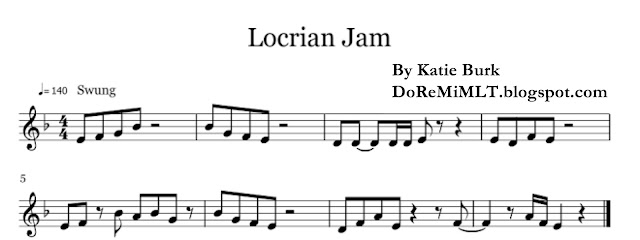
Locrian Jam song!


This song works well with movement activities. Students explore Laban efforts around the room in self-space after spinning our "movement spinner." Another activity for the song: A student with a sign that has Macrobeat written on one side and Microbeat on the other turns the sign to whatever beat they want the class to move to, switching every 4-8 beats. This is also a fun song to have students try snapping on beats 2 and 4, or for students to have a partner that they share a rhythm stick with, swaying side to side or back and forth on macrobeats or microbeats, with each student holding one end of the rhythm stick.


2017 addition: 
Here is an optional B section that you could use for activities such as circle dances or Laban movement opposites! Still swung. :)


Tuesday, August 19, 2014

7 Habits songs: Habit 6: Synergize

SHORT CHANT VERSION:


Habit 6 chant Noteflight notation can be found here.

The coolest part about this song is that the class literally gets to practice synergizing with the "Together is better" chant: one small group starts, and then another group joins in, and another until the whole class is chanting -- creates an effect much better than any kid could make by themselves!!

I had my students repeat the chant, and the second time they added on groups of chanters in the opposite direction (so the first time through the chant rows 1 and 2 started chanting at the beginning, then rows 3 and 4 joined in at the second "Together is better," then rows 5 and 6 so we had everyone chanting by the third "Together is better; synergize!"  Then the next time they added on the parts starting with rows 5 and 6, then 3 and 4, then 1 and 2.

I also had my students synergize in small groups to create a 4-beat body percussion pattern using any combination of stamp, pat, clap, and snap.  They created their body percussion pattern, and performed it 4 times before and after the chant.


LONGER VERSION OF THE SONG:

This one has a minor blues-y feel, and the blues scale used in it can count as Locrian (the song's melody uses primarily E, G, A, and Bb).

See above for how kids synergize for the body percussion patterns and the "Together is better" chant part of the song.

If you wanted, you could even just use the beginning as a short rhythm activity!


I know it's kind of small to read here, so here is the PDF version of the melody only, and here is the PDF version of the melody + chords.

Habit 6 melody is on Noteflight here.

Habit 6 melody + chords notation is available on Noteflight here.
Wednesday, July 23, 2014

Wake Up! Locrian song + rhythmic improv


Songs used: Slow Locrian song from Experimental Songs and Chants without Words and Wake Up! chant from Music Play

My kindergarteners LOVED this activity this year and would always beg for us to keep going longer!! 
Musical concepts covered in this lesson:
  • exposure to Locrian tonality, duple meter, and triple meter
  • vocal exploration (they looooove the tongue trill at the end of the song
  • AB/AAB form
  • 2 meters and 2 tempi, duple and triple + fast and slow
  • piano and forte
  • flow with pulsations
  • rhythmic improvisation

Lesson:
    • Tell the students to lean their heads onto their hands and close their eyes, pretending to sleep. Sing the slow part of the song, gently rocking back and forth on macrobeats. At the fast part of the song, use exaggerated facial expressions and large flicking movements on macrobeats (flow with pulsations) to "wake up." Pretend to stretch from high to low as you do the tongue trill at the end.

    • After the song is over, pick one student who was keeping the beat well to come into the middle. As you sing the song again, their job is to audiate their own rhythm pattern in triple meter. Give examples. They lie in the middle of the circle and pretend to sleep, then wake up, then chant their rhythm pattern on "BA." 

    • That student looks for someone who is really trying their best (or listening well, or keeping the beat well, or moving with flow well, etc.) to be the next improviser. This incentive really motivates all the students to try their best, knowing they may get a turn soon!


Variations/Extensions:

  • Use a cat puppet and a mouse puppet. Tell the students during the song, one of them will move up and down to the macrobeat, and the other to the microbeat. For example, move the cat during the fast section to the eighth notes (microbeat), and move the mouse during the slow section to the dotted quarter notes (macrobeat).     You can also use the two animals to show two different dynamic levels during the two parts of the song.  Which animal was singing piano, and which one was singing forte?

  • Have the student in the middle improvise rhythms in a Q&A rhythm "conversation" with you. Making sure the triple meter tempo you chanted the song isn't TOO fast, you chant one pattern, and they chant something different back to you.


***What Do You Do With a Drowsy Sailor?***
 This activity can also be done with the song "Drunken Sailor," replacing the word "drunken" with "drowsy." I did Drowsy Sailor with 3rd and 4th graders, who loved it and would choose it on music choice day when they had the option between different activities!

For Drowsy Sailor, students stand in the circle, moving the macrobeat in their heels and tapping the microbeat on their shoulders. On the words, "Way, hey, and up," students do a move that they as a class created (my students like moving one arm up and accenting the word "up").

One person is lying in the middle of the circle, and starts to wake up at the words "Way, hey, and up." After the song is over, they improvise a rhythm in duple meter using syllables, such as DU-DE DU, DU-DE DU.