
Showing posts with label Early Childhood. Show all posts
Showing posts with label Early Childhood. Show all posts
Tuesday, May 22, 2018
I'm a Little Snowflake
Way out of season for this one, but again I'm sharing songs I haven't posted yet! This is a lovely Lydian version of I'm a Little Snowflake, which is a chant in Jump Right In.


Wednesday, November 18, 2015
Locrian Jam song!
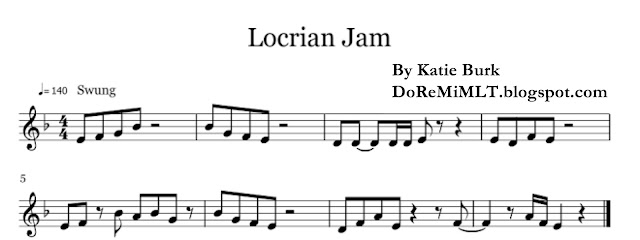
This song works well with movement activities. Students explore Laban efforts around the room in self-space after spinning our "movement spinner." Another activity for the song: A student with a sign that has Macrobeat written on one side and Microbeat on the other turns the sign to whatever beat they want the class to move to, switching every 4-8 beats. This is also a fun song to have students try snapping on beats 2 and 4, or for students to have a partner that they share a rhythm stick with, swaying side to side or back and forth on macrobeats or microbeats, with each student holding one end of the rhythm stick.
2017 addition:
Here is an optional B section that you could use for activities such as circle dances or Laban movement opposites! Still swung. :)

Tuesday, December 2, 2014
Holiday hello song #2: based on Sing We Now of Christmas

A 5/8, secular, hello song based on the Dorian tune "Sing We Now of Christmas." The Noteflight notation is here if you'd like to adapt it for yourself.
Some possibilities for classroom activities with the song:
- You could do the song in duple or triple meter instead of 5/8 and use it to have students echo specific LSA patterns in between repetitions of the song.
- You could do the song without words for early childhood or lower elementary classes.
- Olaf activity:
- Take a snowman prop and pretend he’s Olaf from Frozen. Tell the students we have to tell Olaf with our “BAH” rhythm words that he’s going to melt in summer! Olaf will say something to you, you repeat it back to him to tell him about how snow can’t be warm. Students echo rhythms after Olaf on "BAH.
- Decorating a Christmas tree activity:
- Have students sit and move with flow like they are putting a string of lights around a tree.
- Explore different levels of space based on how students are decorating the tree:
- flow high to put the star on,
- flow low to put presents under tree,
- flow medium-high to put ornaments on,
- do ABA to combine star and presents with motion going high when song is high and low when song is low
- Lift hands and put them down to sing 5-1.
- Singing 5-1, individual students sing after the teacher:
- “touch the top of the tree, bottom of the tree”
- “ceiling, floor”
- “head, toes”
- “high, low”
- Students pretend to put something on the tree and "touch the tree" as they echo a tonal or rhythm pattern after the teacher.
- Repeat the song again, pretending to put more decorations on the tree with flow or beat movement.
o
Sunday, October 5, 2014
Niño Querido: A Round from Spain

A beautiful lullaby and round that you can use in English or Spanish (or without words, especially if you were using this with early childhood). A song with only I and V7 chords, so you can have the kids add Orff instrument parts on top of it (D, D, A, D) or sing the chord roots/chord tones in harmony (DO-DO-SOL-DO, MI-MI-FA-MI, SOL-SOL-SOL-SOL).
Noteflight notation is here.
Wednesday, July 30, 2014
Simon Sings!

Think Simon Says, but to help the kids think about the difference between singing voice and speaking voice.
You don't use the words Simon Says at all. You simply give an instruction either using your singing voice or your speaking voice. The students are only to follow the instructions you SING, not the ones you speak in the game. If a student follows a direction you SPEAK, they're out and they sit down!
I like to improvise in Dorian or Phrygian mode to give the directions in the game. You also can sing tonic and dominant patterns in major or minor tonality, later adding in subdominant patterns. The purpose is for the kids to practice and for you to assess how they're doing with hearing the difference between singing and speaking voice!
Extension:
If my students are REALLY good at hearing singing vs. speaking (which my K and 1st graders are!), I make it even trickier for them! If I sing the directions on the RESTING TONE, they should follow them, but if I sing the directions on ANY OTHER NOTE, they shouldn't follow them! This helps me assess whether students are truly audiating which pitch is the resting tone!
Wednesday, July 23, 2014
Wake Up! Locrian song + rhythmic improv
Songs used: Slow Locrian song from Experimental Songs and Chants without Words and Wake Up! chant from Music Play
My kindergarteners LOVED this activity this year and would always beg for us to keep going longer!!
Musical concepts covered in this lesson:
- exposure to Locrian tonality, duple meter, and triple meter
- vocal exploration (they looooove the tongue trill at the end of the song
- AB/AAB form
- 2 meters and 2 tempi, duple and triple + fast and slow
- piano and forte
- flow with pulsations
- rhythmic improvisation
Lesson:
- Tell the students to lean their heads onto their hands and close their eyes, pretending to sleep. Sing the slow part of the song, gently rocking back and forth on macrobeats. At the fast part of the song, use exaggerated facial expressions and large flicking movements on macrobeats (flow with pulsations) to "wake up." Pretend to stretch from high to low as you do the tongue trill at the end.
- After the song is over, pick one student who was keeping the beat well to come into the middle. As you sing the song again, their job is to audiate their own rhythm pattern in triple meter. Give examples. They lie in the middle of the circle and pretend to sleep, then wake up, then chant their rhythm pattern on "BA."
- That student looks for someone who is really trying their best (or listening well, or keeping the beat well, or moving with flow well, etc.) to be the next improviser. This incentive really motivates all the students to try their best, knowing they may get a turn soon!
Variations/Extensions:
- Use a cat puppet and a mouse puppet. Tell the students during the song, one of them will move up and down to the macrobeat, and the other to the microbeat. For example, move the cat during the fast section to the eighth notes (microbeat), and move the mouse during the slow section to the dotted quarter notes (macrobeat). You can also use the two animals to show two different dynamic levels during the two parts of the song. Which animal was singing piano, and which one was singing forte?
- Have the student in the middle improvise rhythms in a Q&A rhythm "conversation" with you. Making sure the triple meter tempo you chanted the song isn't TOO fast, you chant one pattern, and they chant something different back to you.
***What Do You Do With a Drowsy Sailor?***
This activity can also be done with the song "Drunken Sailor," replacing the word "drunken" with "drowsy." I did Drowsy Sailor with 3rd and 4th graders, who loved it and would choose it on music choice day when they had the option between different activities!
For Drowsy Sailor, students stand in the circle, moving the macrobeat in their heels and tapping the microbeat on their shoulders. On the words, "Way, hey, and up," students do a move that they as a class created (my students like moving one arm up and accenting the word "up").
One person is lying in the middle of the circle, and starts to wake up at the words "Way, hey, and up." After the song is over, they improvise a rhythm in duple meter using syllables, such as DU-DE DU, DU-DE DU.
Monday, July 21, 2014
Kindergarteners chanting in 7/8!
My students LOVE chanting in unusual meters! Here's a video of kindergarteners moving with flow using bean bags, as they chant a song in 7/8 meter.
Here's the notation for the chant:


Moving with flow helps them to feel the space between the beats and prevents rushing as they sing, giving them a stronger sense of steady tempo!
Here's the notation for the chant:
Sunday, July 20, 2014
Dory the Dorian song :)

Lesson plan idea:
Sing the song while sitting and
moving with flow. Tell the class we're going
to pretend to be Dory the fish, and show them one hand moving like a fish,
still moving with continuous flow but with obvious squiggles in the air from
that hand.
Chant triple meter patterns (Verbal Association or Aural/Oral) to individuals between repetitions of the song. If you have a marine animal toy, have the student say their pattern to that animal! (My students love saying patterns to my big inflatable dolphin. ;)
Each time through the song, change what kind of underwater animal the class is pretending to be--dolphins, stingrays, turtles, whales, minnows, etc. Get student ideas for this - they LOVE giving ideas!
If the animal is larger, like a whale, the teacher can use both arms and a wider amount of space for the flow.
If the animal is smaller, like a minnow, the teacher can have them just flow with a pinky.
The teacher could also suggest to be stingrays flowing in low space, or dolphins flowing in high space, not expecting the children necessarily to contribute to ideas for the animals but only using the ideas as a guide for variation in the movement the teacher models.
Chant triple meter patterns (Verbal Association or Aural/Oral) to individuals between repetitions of the song. If you have a marine animal toy, have the student say their pattern to that animal! (My students love saying patterns to my big inflatable dolphin. ;)
Each time through the song, change what kind of underwater animal the class is pretending to be--dolphins, stingrays, turtles, whales, minnows, etc. Get student ideas for this - they LOVE giving ideas!
If the animal is larger, like a whale, the teacher can use both arms and a wider amount of space for the flow.
If the animal is smaller, like a minnow, the teacher can have them just flow with a pinky.
The teacher could also suggest to be stingrays flowing in low space, or dolphins flowing in high space, not expecting the children necessarily to contribute to ideas for the animals but only using the ideas as a guide for variation in the movement the teacher models.
My favorite ideas from the kids: shark and plankton! Make the movement and dynamics small if the animal is small, and big if the animal is big! J
§
Curricular
rationale: continuous flow, body awareness, high and low space, exposure to
Dorian, rhythm patterns in usual triple
***Rhythm Creativity Alternative!***
Using the dolphin or other stuffed marine animal, have rhythm conversations with the students! Ask the kids to put a finger on their nose if they want a turn. When the teacher comes up to them, they should chant something DIFFERENT than what the "dolphin" just chanted. :)
To show the students to audiate before they chant, the teacher shows the dolphin whispering in his/her ear. The teacher then chants the pattern the dolphin "whispered" to him/her.
***Rhythm Creativity Alternative!***
Using the dolphin or other stuffed marine animal, have rhythm conversations with the students! Ask the kids to put a finger on their nose if they want a turn. When the teacher comes up to them, they should chant something DIFFERENT than what the "dolphin" just chanted. :)
To show the students to audiate before they chant, the teacher shows the dolphin whispering in his/her ear. The teacher then chants the pattern the dolphin "whispered" to him/her.
Subscribe to:
Posts (Atom)